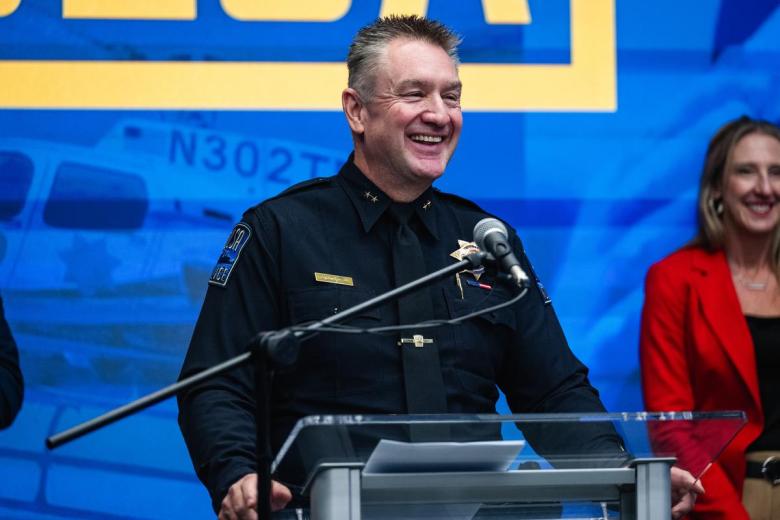
During a fireside chat with District 1 City Councilwoman Vanessa Hall-Harper, Tulsa’s new police chief Jonathan Brooks said he has a few priorities over the next 100 days: increasing community partnerships, meeting with each officer in the department and expanding community engagement.
“I’ll be going around listening to as many Tulsans as I can as we start developing our public safety policing plan for this city,” Brooks told a crowd gathered at the 36th Street North Event Center Monday night.
Hall-Harper’s event came a few days after Brooks met community members during a meet and greet hosted by 100 Black Men of Tulsa at Greater Grace.
Donald Tyler, the senior pastor, told The Eagle he’s concerned about police accountability and 911 response times.
“That’s what everybody wants to know, ‘who supervises the police department,’” he said. “Of course they work directly for the mayor, but they’re really accountable to us. We have to hold them accountable.”
Hall-Harper asked Brooks his thoughts on previous issues within the department and how they might be handled differently under his leadership.
Where is the new police chief headed next?
Tulsa Mayor Monroe Nichols will host a series of community conversations for residents to meet Brooks and other public safety leaders. All will last from 5:30 to 7 p.m.
- Oct. 26: Tulsa Tech Lemley Memorial Campus, 3420 S. Memorial Drive.
- Oct. 29: Herman & Kate Kaiser YMCA, 5400 S. Olympia Ave.
- Nov. 2: Hardesty Regional Library’s Frossard Auditorium, 8316 E. 93rd St.
- Nov. 5: Rudisill Regional Library’s BOK Harmony Hall, North Meeting Room, 1017 N. Greenwood Ave.
Public records requests
Brooks said one thing putting stress on the department’s ability to process requests for records like police body cam footage is a sheer volume issue.
“At any given moment we take hundreds of (Open Records Act) requests per day. In fact, the police department I think may take more open records requests than the rest of the city alone,” he said.
He said TPD currently doesn’t have enough people to handle that amount but they’re working to increase capacity and the department’s “ability to conform with the law.”

Use of Flock cameras
TPD’s use of Flock Safety automatic license plate readers has garnered backlash from advocates and residents wondering where the cameras are and how the gathered data is being used.
One audience member questioned the number of Flock cameras deployed across Tulsa and asked why the public had to subpoena to find out their locations since the department is a public agency.
Brooks estimated police had installed about 100 cameras but the “city in general has well over 200 cameras because businesses, neighborhood associations, even individuals” can put up cameras.
Two situations where TPD has used Flock camera data was for a Silver Alert about a missing senior citizen and “to identify a homicide suspect’s vehicle,” he said.
He said there are “a lot of misconceptions” about the cameras but added that the department is “conducting a review” of its use of Flock cameras.
Officer shortage
The department is understaffed by around 150 officers, Brooks said. He believes that’s in large part because “policing right now is a tough profession, nationally,” and people’s views of law enforcement have changed, making it difficult to recruit.
But, he told the crowd, “policing can be the most rewarding job you could ever have.” He encouraged those who “want to see policing change” to join the force.
Hall-Harper, who teaches government courses at Tulsa Community College, said when she talks to students about careers, they have rarely said they want to pursue a career in law enforcement. That’s largely due to concerns about accountability and trust, she said.
Community-based violence prevention
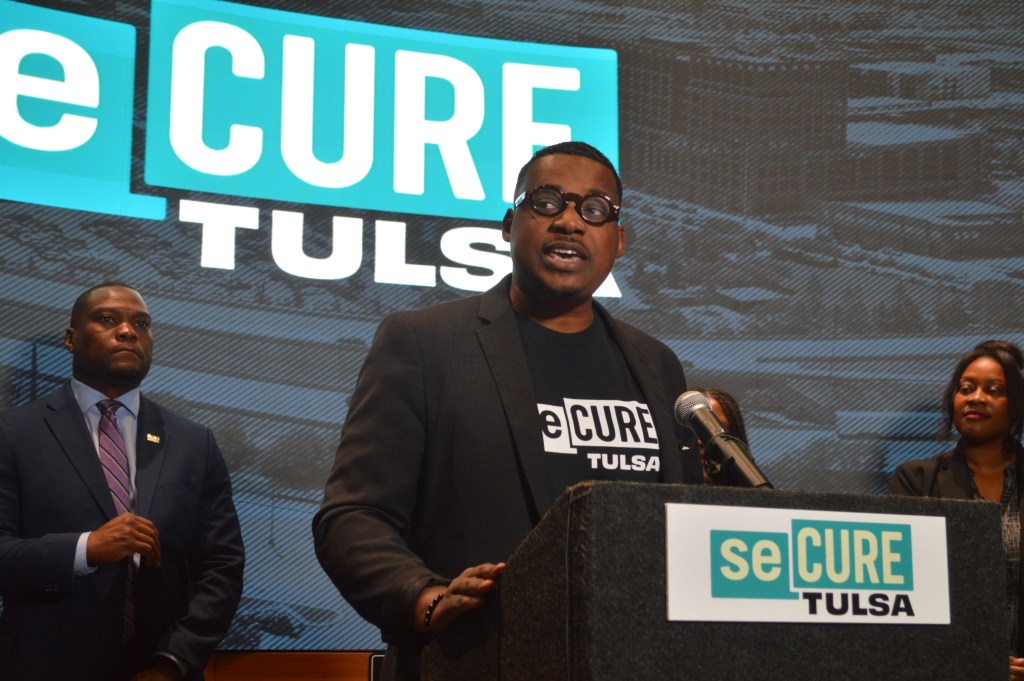
In May, the city relaunched Secure Tulsa, a community-based violence intervention initiative. Instead of relying solely on police to address conflict, the effort enlists the help of trusted messengers in the community to build rapport with youth and help resolve issues before they become violent.
Brooks said he supports community-based violence prevention efforts and sees a lot of opportunities in Tulsa’s initiative.
Still, he said the same way that the police department has to be accountable for better outcomes, so do community-based violence prevention groups.
“I always say that we need to go further upstream and start our problem solving as a community,” Brooks said. “If we want better outcomes when they get older, we have to start even earlier.”
Closing encampments and homeless sweeps
Gov. Kevin Stitt’s office recently sent a letter to police chiefs in Oklahoma City and Tulsa outlining how much money the state had spent in helping both cities clear homeless encampments, Oklahoma Watch reported in August.
Stitt’s controversial Operation SAFE initiative saw state troopers clear homeless encampments on state property last year. The letter did not demand immediate payment but warned the state will attempt to pass legislation to recover costs for encampment cleanups.
On Monday, Brooks responded to the letter.
“I set the directive on how we operate and then I get my orders from the police commissioner and the mayor,” he said. “I don’t take them from the governor or anybody in the state.”
In regards to Tulsa’s Safe Move initiative moving people experiencing homelessness into housing, Hall-Harper asked Brooks whether TPD had a written policy for how to handle people’s personal items — such as IDs, medications, documents — during encampment closures.
While TPD has “policies about care and custody and property for an individual if they get arrested or if they’re relocated,” another agency handles those personal items, Brooks said.
911 crisis response and mental health calls
Brooks said the 911 call center is very close to being fully-staffed. It’s necessary to review present-day technology needs that could make these processes smoother, he added.
In response to calls for mental health crises, Brooks highlighted Tulsa’s mental health professionals in the department to respond to calls where appropriate.
The family of Michael Glunt, a man shot nine times by Tulsa police in February, said he was experiencing a mental health crisis when he was killed.
“A lot of our calls should not be a police officer,” Brooks said. “We have our community intervention teams, our crisis response teams, as an alternative response.”
Still, he acknowledged, the department needs more mental health clinicians. Councilors have discussed ways to expand services so they are available 24 hours a day, Hall-Harper said.