


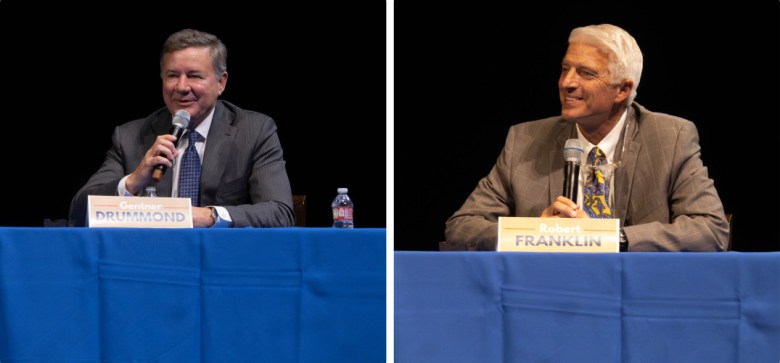
Two Republican candidates — one hoping to become Oklahoma’s next governor and the other running for state superintendent — talked about party purity tests and the state’s poor national rankings Tuesday night at a forum hosted by the Tulsa Press Club and The University of Tulsa.
Attorney General Gentner Drummond outlined a tax plan he would promote as governor that doesn’t cut core services. He also defended his opposition to an Inola aluminum smelter and pushed his priorities of improving healthcare, mental health services, education and the state’s relationship with tribal nations.
State superintendent candidate Robert Franklin connected his nearly 45 years in secondary and CareerTech education to his detail-oriented and consensus-building governing style.
The other candidates appearing on the Aug. 25 GOP runoff ballot did not attend. Gubernatorial candidate Mike Mazzei’s campaign did not respond to multiple invitations, and state superintendent candidate James Taylor was at a fundraiser in Kay County.
Their absences turned the forum into a conversation without time limits on questions posed by journalists from the Tulsa Flyer, Tulsa World and Oklahoma Watch, moderated by Tulsa Press Club President Jason Collington. The crowd of about 100 arrived early and stayed late to meet the candidates in person and occasionally clapped for answers.
Early voting runs from Aug. 20-22, with Election Day on Aug. 25. Find more information about what’s on your ballot and where to vote at the Flyer’s voter guide.
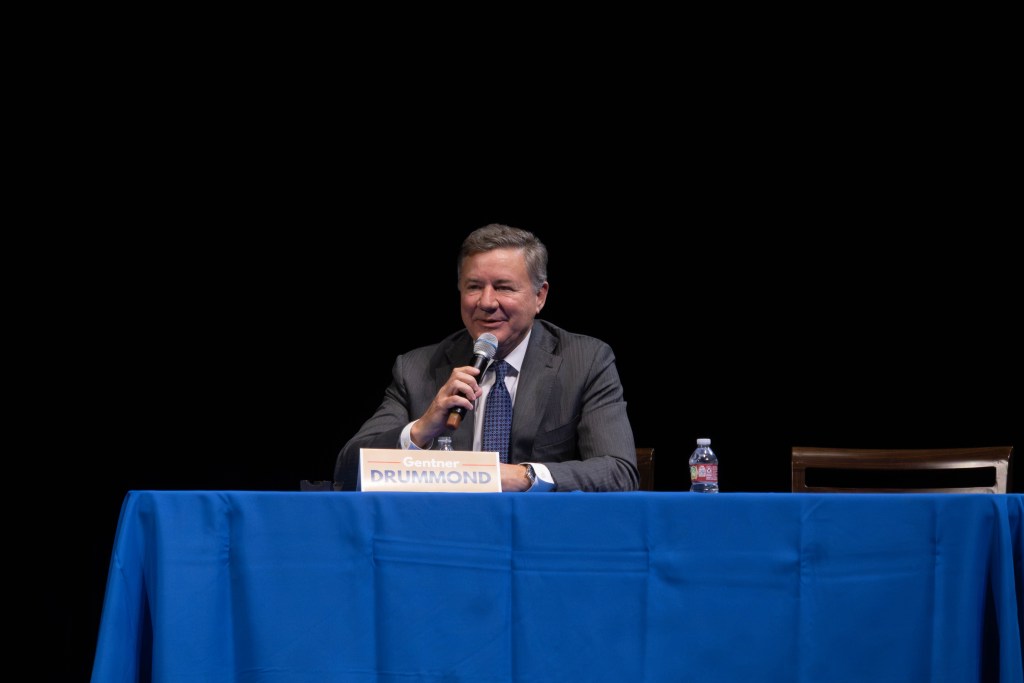
Drummond on Republican politics, Inola smelter and more
- Drummond said he agrees with 85% of Gov. Kevin Stitt’s policy positions but disagrees with areas “adverse to law.”
- He pointed to actions he said were right but politically unpopular, including opposing the establishment of the St. Isidore of Seville Catholic Virtual Charter School, which sought public dollars to create a private religious school; settling the pending 21-year lawsuit against poultry companies after a federal judge released findings in favor of the state; and suing two insurance companies on allegations of having schemes to wrongfully deny or underpay valid claims by homeowners.
- He said $1 million is being spent against him weekly in this campaign from out-of-state corporations that are “used to their governor being more compliant.”
- A Republican for most of his life, Drummond said he does not “bend to a two-party politic.” He said both parties typically want “the most extreme candidate to be their banner waver” and doesn’t think that is good for the 4 million diverse Oklahomans. “I aspire to be the governor of all, and that sometimes draws me in sharp contrast with extreme members of the Republican party. But I don’t think they are real Republicans. I consider them more fascists.”
- Drummond said he is aligned with President Donald Trump on criminal justice and border security. He has been to the White House twice in the past three months, once to brief Vice President J.D. Vance on successes of Medicaid fraud enforcement through Drummond’s office. The other was to inform U.S. Attorney General Todd Blanche of the state’s organized crime task force that Drummond created three years ago and has led to the elimination of 1,600 illegal marjuana growth facilities.
- He said he disagrees with Trump on building a $4 billion aluminum smelter in Inola, a project supported by Mazzei. Drummond said his opposition comes from the project transferring 633 acres of Oklahoma land to a “Muslim monarchy” that would be underwritten by $255 million in state tax dollars and hundreds of millions more in federal funds. He said the pollution would include about 55,000 gallons of wastewater produced every two hours. “It will be Tar Creek 2,” referring to the 11-mile environmental Superfund site in Ottawa County that cost more than $300 million to remediate and forced the closure of the town of Picher.
- Cutting income tax to zero in four years will “create chaos,” he said. It would restore the recently eliminated tax on groceries and remove all sales tax exemptions including those on youth nonprofits. Consumption, corporate and gross production taxes would all increase to make up the difference, he said.
- The candidate is for lowering taxes but not at the expense of cutting services in healthcare, education and mental health. “You have to build before you cut,” Drummond said. He pointed to rankings putting Oklahoma 50th in education, 48th in healthcare and 46th in mental healthcare services, plus ranking as the 39th least popular state for business.
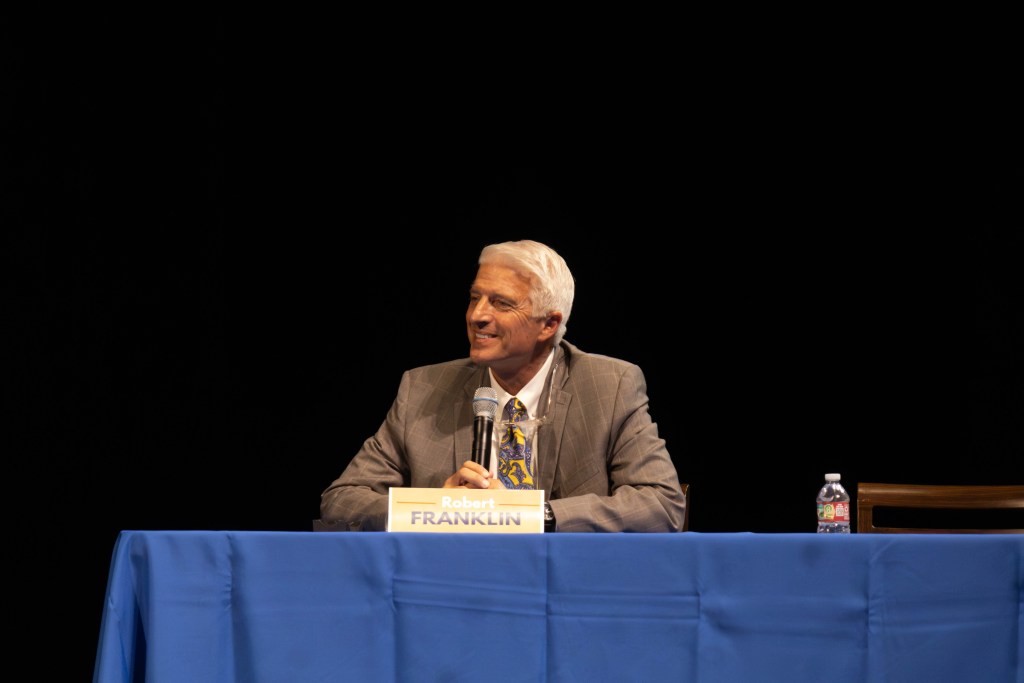
Franklin on turning around Oklahoma schools, political history
- Franklin’s doctoral thesis was on his pioneering work in developing online curriculum. That started when he was an assistant junior high principal, finding no options for students on long-term suspensions to keep up with work. With success in virtual learning for at-risk youth, he then expanded to gifted students seeking more challenging coursework. Surrounding districts took note of the program and eventually formed a consortium to share best practices. He would encourage similar frameworks as state superintendent.
- Franklin said he is distressed by Oklahomans who have hardened positions against public education. “For me, there is a sense of urgency to say we’ve got one more bite at the apple to get public education on the right track. … Let’s get rid of the politics and let’s get into the real work because there’s some heavy lifting we’re going to have to do,” he told the audience.
- Without educator input on legislation, Franklin said, good intentions can bring poor results, such as the rollout of the increased recess mandate. “This really is an example of when overreach happens and local schools and teachers are not involved in the equation of solving a problem,” he said.
- Franklin promoted the science of reading as a model and stressed interventions earlier than third grade.
- He said Oklahoma education can turn around with a united governor, state superintendent and state school board working with public education as top priority. “It’s just everybody trying a lot of different strategies that have caused us to perhaps lose our focus. It’s going to take a really targeted effort to get us on the right track. I think we can win.”
- The A-F School Report Card system used by the state “hides more than it reveals,” he said. “It’s flawed by design, largely because you’re trying to skinny everything down to a single test or to a single grade.” He said he would recalibrate the accountability measure to meet federal guidelines and provide parents useful information.
- As chair of the Oklahoma Statewide Virtual Charter School Board, he was among the minority vote against the St. Isidore of Seville Catholic Virtual Charter School receiving public funds. “I look back on that and can say it had nothing to do with my religious convictions or what I thought the archdiocese was trying to do in regard to their religious perspective,” he said. “This had to do with constitutional provisions.”
- Franklin said he’s always considered himself conservative, even when he registered as a Democrat in 1979 in McIntosh County. At that time, more than 75% of Oklahomans were registered Democrats. He switched to Republican four years ago. “I’m not a politician but have always been conservative in my principle perspectives.”
- He said he has voted for candidates of both parties. “I don’t try to vote for a political party or platform, and I’ve really been criticized about that. What I always say to that particular criticism: Ronald Reagan did that and so did Donald Trump as have many other Oklahomans across this landscape who have been here for more than a decade.”
News decisions at the Tulsa Flyer are made independently of our board members and financial supporters. Read more about our editorial independence policy here.