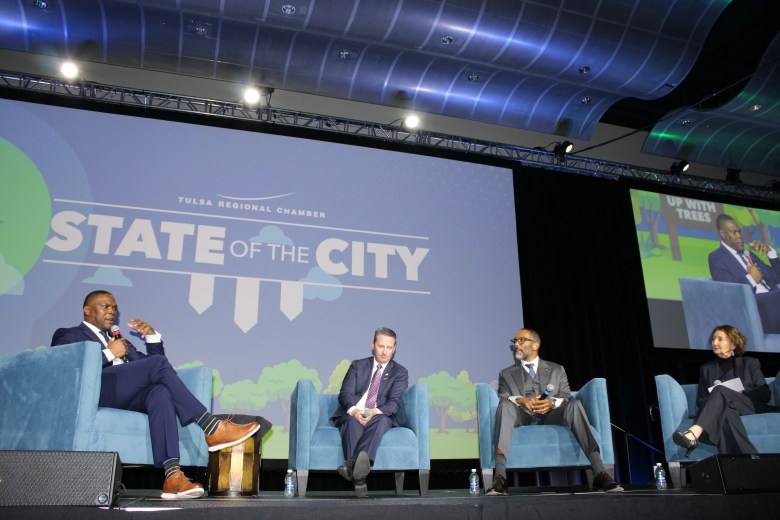
About $1 billion could be spent to transform northwest downtown, a development that Mayor Monroe Nichols said could be a turning point for the city.
Project Nexus was the highlight of the Tulsa Regional Chamber’s annual State of the City event Thursday. With an early price tag ranging from $850 million to $900 million, it’s set to reimagine northwest downtown with blocks of mixed-use development, housing and a new soccer stadium for FC Tulsa.
It would also relocate the David L. Moss Criminal Justice Center and other social service providers along Archer Street to outside of downtown.
“I believe we’re approaching one of the most consequential moments for downtown in our city’s history,” Nichols said Thursday. “In fact, I would argue that this is an inflection point for our entire city.”
The developers behind Nexus, which include Williams, submitted a preliminary application with the city in September to create a tax increment financing district — or TIF — that would cover more than 22 blocks, according to the Tulsa World.
Nichols acknowledged the implications of what Project Nexus could do to the nonprofit space through displacement, but he argued that the city can’t squander this opportunity for growth.
He said Tulsa lost out on 150 conventions in 2025 due to a lack of a convention center hotel as an example of gaps hurting the city’s economy. Tulsa Regional Tourism shared a similar sentiment in 2024. However, the group said only 32 events were missed last year as a result of not having a convention center hotel.
Monroe said downtown is an important economic engine for the city that will help set Tulsa apart from its competitors. Williams CEO Chad Zamarin agreed.
“We believe that by bringing investment into the city, we can create an attraction for the talent, the workforce of the future,” he said. “But we can also create an investment opportunity to, frankly, reconstitute and reinvigorate the social services that struggle to keep up with the need.”
This comes at a time where small businesses downtown are struggling to survive due to a lack of sales and lingering effects from the COVID pandemic. Nichols told The Eagle on Monday that the city has to do more to support small businesses.
“Project Nexus, as you read about, is a reflection of Tulsans who believe deeply in what Tulsa can become,” Nichols said. “These are folks not interested in sitting back and being spectators but instead bringing the kind of fiduciary leadership that has always built who we are in the city.”
If the Nexus TIF is approved, Phase 1 is estimated to be complete by 2030, which would include the FC Tulsa stadium as well as housing and office, hotel and retail space.
Ismael Lele is a Report for America corps member and writes about business in Tulsa for The Oklahoma Eagle. Your donation to match our Report for America grant helps keep him writing stories like this one; please consider making a tax-deductible gift of any amount today by visiting this link.