The scene: the opening of the school year at Charles Page High School in the Tulsa suburb of Sand Springs. The time: August 1964. Nine Black students entered the building, opened their books and made history.
They became the first Black students at the newly desegregated school. The students were Dollie Chambers, Cortez Johnson, Marcia Jones, Calvin Long, Keith Robinson, Marvin Stewart, Betty Towns, Douglas Westbrook and Vicki Westbrook. They were members of the classes of 1965, 1966 and 1967, all transfers from the Sand Springs’ all-Black Booker T. Washington School.
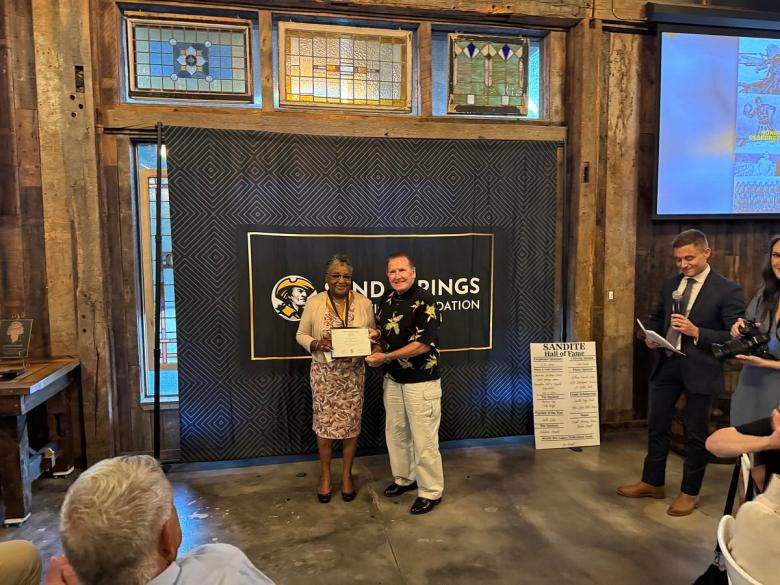
On April 16, at its annual dinner, the nonprofit Sand Springs Education Foundation inducted all nine into the Sandite Hall of Fame. Only Long, Towns and Vicki Westbrook were alive to receive the honor, while the others received posthumous inductions.
Nine brave students
Bob Lemons, president of the class of ’64, and Betty Towns (Jackson) accepted the Hall of Fame plaque on behalf of the other recipients.
“We honor these nine brave students and the classmates who supported them,” said News on 6 anchor Reagan Ledbetter, the event’s master of ceremonies.

The packed room at Bright Morning Farms, the scene of the awards banquet, erupted in a thunder of applause.
During a reception before the event, Mayme Crawford, a longtime advocate in Sand Springs’ African American community, recalled the early days of school desegregation there.
“What I remember is how quietly it all took place,” she told The Oklahoma Eagle. “There may have been a lot of fuss going on, but we as students just went about our business learning.”
Lemons, who flew in from his home in Ohio for the event, shared a similar recollection.
“The whole thing was kept pretty calm,” he said in an interview during the reception. “It went peacefully and without any issues.”
The calm contrasted with the tension and violence that had emerged during similar efforts to integrate schools in Little Rock, Arkansas, and other cities across the South.

Seeking greater opportunity
John Neal, a former reporter for The Oklahoma Eagle and member of Charles Page’s class of ’64, has written extensively about the school’s desegregation for The Eagle and the Tulsa-based Committee for Public Secrets.
Neal documented contentious discussions in Sand Springs’ Black and white communities in the months before desegregation eventually occurred. Black students had initially been turned away from Charles Page as the Sand Springs school board at first fought hard against desegregation. They relented under the threat of federal intervention.
“Nine Black students attended CPHS in 1964,” Neal wrote in an article in the Center for Public Secrets in 2023. “The three seniors, one junior, and five sophomores who were admitted did not know what to expect. They had all witnessed the reluctance and fear within the Black community. They had experienced resistance from the white school board and school superintendent, as well as fearful admonishments from school administrators. Yet they had all volunteered, seeking a better education and greater opportunity.”
Neal, according to classmates, was among a handful of students at Charles Page who embraced the new students and helped them navigate the opportunity.