The City of Broken Arrow filed a motion to dismiss the Islamic Society of Tulsa’s religious discrimination lawsuit on Friday, arguing the city council’s January denial of a proposed mosque and commercial complex was not motivated by religious bias.
“Broken Arrow does not discriminate based on religious practice or beliefs. Indeed, the record in this case will reflect at least one individual defendant referred to Muslim residents as ‘our Muslim brothers and sisters,’” the filing reads.
Attorneys from Atlanta-based law firm Troutman Pepper Locke argue the Islamic Society fails to show how the city violated state and federal religious discrimination laws when denying their application by a 4-1 vote. The city is paying the firm $925 an hour for legal services related to the lawsuit and a Department of Justice investigation.
The denied proposal followed a special meeting that attracted more than 1,000 people and a social media frenzy of anti-Islamic comments. Broken Arrow’s filing acknowledges the “significant public interest” in the case and the removal of some “disruptive” people from the January meeting. But the application was treated the same as any other, attorneys argue.
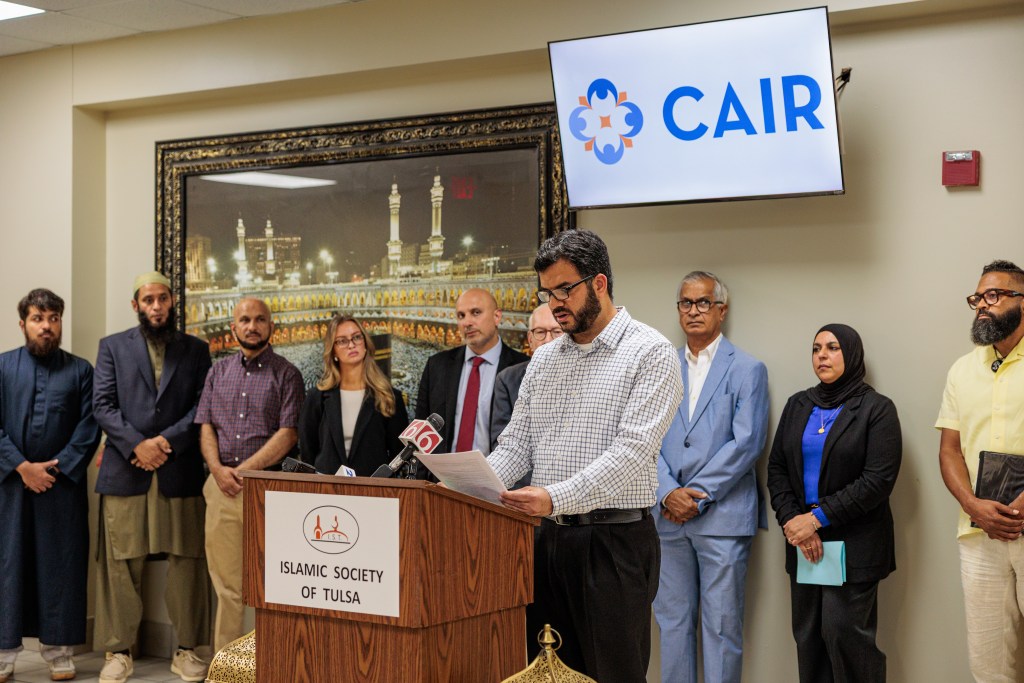
“Like any other religious institution or assembly, (the Islamic Society) must comply with the City’s land use policies, which are facially neutral between religious and non-religious uses, neutral among religious denominations, and administered in a way that does not discriminate or substantially burden anyone’s free exercise of religion,” the filing reads.
In a separate filing, lawyers for the city also said councilors cannot be held personally liable for land use decisions.
“These decisions require the exercise of each individual member’s discretion and independent judgment. As such, it is essential that they be permitted to execute their duties without fear of litigation and potential personal liability,” the filing reads.
The Islamic Society’s August lawsuit accuses the city of violating state and federal laws prohibiting religious discrimination when denying its requests to build a mosque and commercial complex on 15 acres along South Olive Avenue just south of the Creek Turnpike.
Councilors have said their decision was solely based on land use concerns like traffic congestion, water quality and compatibility with the city’s comprehensive plan. But a Tulsa Flyer investigation published in July revealed some councilors privately agreed with anti-Islamic sentiments in their communications with the public.
In a 33-page filing, attorneys for Broken Arrow argue those communications are “insufficient” to show a majority of the five-person city council acted with discriminatory intent.
“Plaintiff’s out-of-context quotations plucked from broader correspondence by two City Councilors and Plaintiff’s other circumstantial allegations are insufficient to support an inference that a majority of the Council acted with discriminatory intent,” the filing reads. “As a result, all Counts that rest on allegations of discriminatory intent should be dismissed.”
Attorneys from the Council on American-Islamic Relations Legal Defense Fund and Tulsa-based Laizure Law are representing the Islamic Society. Meghan Murphy, a CAIR staff attorney, said in August Broken Arrow imposed “uniquely high engineering and evidentiary standards” on the mosque application that were not held to other institutions, including nearby churches.
Email communications revealed why the mosque application was denied, Murphy said.
“(Councilors) did not want a mosque in their city. They did not want Muslims here,” Murphy said. “So, they made up a reason, and in doing so they violated the law.”
A CAIR spokesperson did not immediately respond to requests for comment, and an Islamic Society leader said he had not yet read the filings.
Attorney weighs in on what’s next
U.S. District Judge Sara E. Hill, who was appointed to the Northern District Court in Oklahoma in 2024, is presiding over the case.
The suit could stretch on for years as city and mosque attorneys trade motions and go through the process of discovery and depositions, said Dan Dalton, a Detroit-based attorney who specializes in religious land use cases. It will come down to the judge and speed of scheduling, he added.
Dalton was among the attorneys the Islamic Society consulted shortly after the January vote. Later, in May, he visited Tulsa to speak about his expertise at the Oklahoma Association of Municipal Attorneys’ spring conference.
What stood out to him about the case was the length of time the Islamic Society owned the property with the expressed purpose of building on it. The organization purchased the land in 2014. If there was a problem with the zoning or master plan, Dalton said, the city could have taken action years ago.
The vitriol of public comments opposing the mosque and city council’s approval of a nearby property for secular assembly also lend themselves to the Islamic Society’s case, Dalton said. Federal law requires religious institutions to be treated the same as secular groups.
“If I was the plaintiff’s attorney, I would be licking my chops on this one,” Dalton, who is not involved in the lawsuit, told the Flyer in August. “This is a great religious claims case as a plaintiff.”
Dalton said it’s “not a good case at all” for the City of Broken Arrow.
“If I was them, I’d be looking for any possible way to mitigate my damages,” Dalton said.
News decisions at the Tulsa Flyer are made independently of our board members and financial supporters. Read more about our editorial independence policy here.