You may have read it’s a buyer’s market right now, with more homes for sale than active buyers. Mortgage rates also fell below 6% in February for the first time in years, but that doesn’t necessarily mean housing is becoming more affordable.
The pandemic-era days of 2-3% interest rates were abnormal, says Sally Perez, owner of EXIT Reality Connexx, a small real estate company in Tulsa. Perez has been in the industry for more than 30 years, often working with young homebuyers. Things are starting to level out after the pandemic housing boom drove up prices to unprecedented levels, she said.
“Our market is correcting to a normal real estate market,” Perez said. “During COVID … I had a listing in Broken Arrow — I had 48 showings in 26 hours and 19 offers.”
That home ended up selling for $20,000 more than the list price, she said.
Perez says young people who bought a home for more than it was worth during the pandemic are “gonna take a bath today” or suffer financial losses. As a result, those homes just aren’t for sale.
Since young homeowners are struggling to sell their current home for a profit and also afford their next one, first-time homebuyers are finding fewer options in their price range. First-time homebuyers typically look in the $150,000 to $250,000 range, Perez says, and second-time homebuyers tend to look in the $250,000 to $400,000 range.
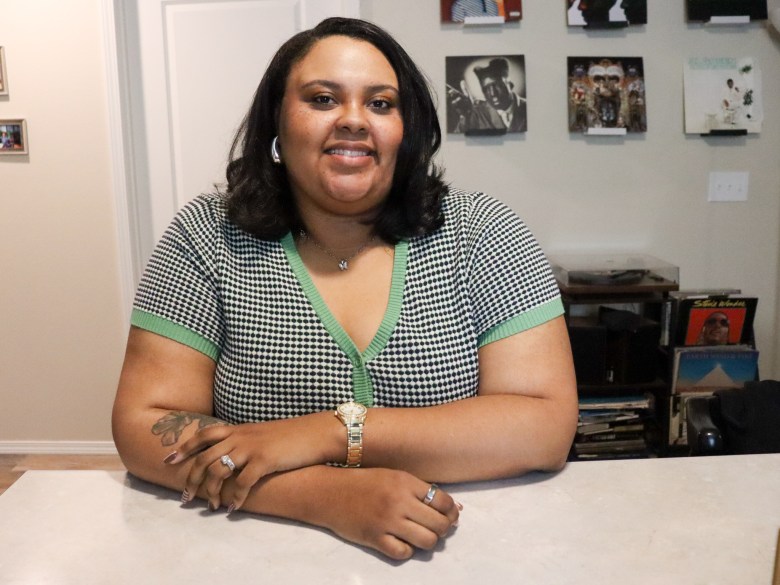
Kennedy Dixon, 27, wanted to defy the odds. As a young Black woman, she says owning a home is an “anomaly.” At 25, she bought her first home in north Tulsa for $170,000. It’s worth almost $240,000 now.
“For a lot of us, it is hard to attain a lot of the small things, a lot of the simple things,” Dixon said. “So to attack something like buying my first home was a big feat.”
She secured down payment assistance through the Green Country Habitat for Humanity, which is only available to homes built by the nonprofit organization. Dixon received about $30,000 in financial help, but it varies from person to person, according to Josh Wagner, a Habitat spokesperson.
Dixon doesn’t see herself in the market for a new home for at least five or 10 years. But for those looking to level up, homes in the $250,000 to $400,000 range look different around Tulsa.
Near 46th Street and South Pittsburgh Avenue, a 2,100-square-foot house is selling for around $425,000. Perez says if you picked up that house and moved it north across Admiral Place, it’d cost you around $250,000 to $300,000 instead.
Similarly, Perez has a 1,670-square-foot house east of 24th Street and Memorial Drive with four beds and two baths listed for $230,000. If you go a little bit west at 25th Street between Yale Avenue and Sheridan Road, you’ll find a 1,100-square-foot house with three bedrooms and one-and-a-half baths for $210,000.
“The biggest problem with prices today are realtors,” Perez said.
Prices tend to be too high, she says, because that cost is usually based on the last six months. She chooses to look at the last 60 days when advising sellers on pricing.
It was a different market six months ago than it is today, Perez says. She’s seen $10,000 cost differences, which she says makes a big impact for young homebuyers.
Nationally, Tulsa ranked 20th among the top 100 largest cities where the median sale price buys the most space, according to a recent Property Shark study. With $400,000, Tulsans could get 2,371 square feet. Oklahoma City ranked just behind Tulsa, at 2,368 square feet for the same price.
News decisions at the Tulsa Flyer are made independently of our board members and financial supporters. Read more about our editorial independence policy here.