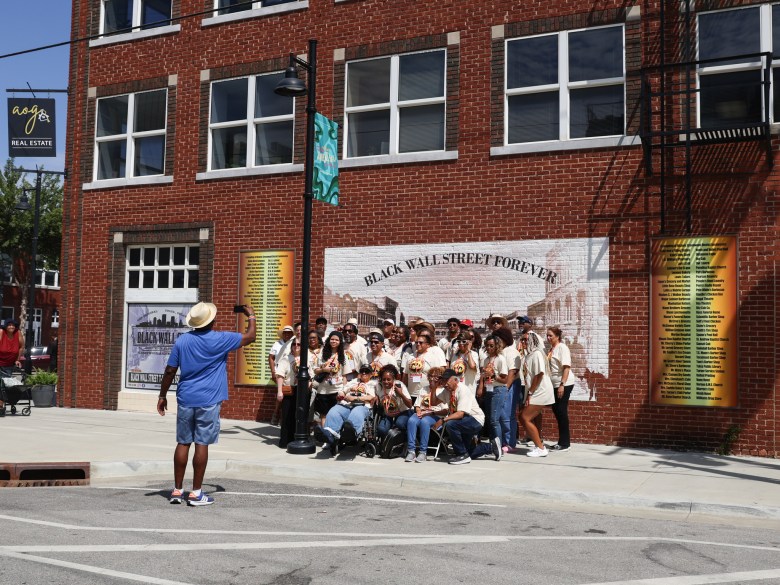
The Black Wall Street Chamber is undergoing a revitalization effort with plans to officially relaunch this spring. It formed in 2018 in response to grievances its original members had with the Greenwood Chamber of Commerce, which is celebrating its centennial this year.
The Oklahoma Eagle sat down with Black Wall Street Chamber chairman Darnell Blackmon to learn more about the future of the organization, which he’s led since August.

The following interview has been edited for length and clarity.
Ismael Lele: Describe the current state of the Black Wall Street Chamber.
Darnell Blackmon: We are going through what I call a renaissance. We’re having some talks currently about partnering with Google about some entrepreneurship programs for some of our youth and some of the older adults in terms of learning entrepreneurship technology. We hope to partner and push out an agenda that’s going to be able to track and measure outcomes.
What will the chamber’s annual budget be?
We’re actually getting that budget together now to push it out. I’d like to say that my budget is like, $10 million, (but) we don’t have it like that. Some of the things that we do we’re going to do for free because we don’t have a budget.
Can you explain the difference between the Black Wall Street Chamber and the Greenwood Chamber and the history between the two?
The difference becomes the people who are running it and how much they’re willing to put into it. Historically, I understand that there was a Greenwood chamber (and) there were some people who didn’t quite agree. I don’t know what the disagreement was about, and really it doesn’t matter because any chamber or any organization should be collectively working together. My goal is for the chambers to work together, to be friends. We can have functions together — however that looks — that’s what should happen. I don’t want to be in competition with them.
A former employee of yours, Donald Rose, made a Facebook post in January accusing the chamber of mismanaging philanthropic funds. He also accused the chamber of withdrawing from public engagement. What’s your response to those allegations?
Those allegations are not true. I appreciate Donald and who he is and what he represents. I came to the chamber as this stuff was getting to a head, so I had to learn anecdotally about a lot of it, but Donald was at the chamber as a volunteer and was not supposed to be a paid member.
I do understand that he received some funds that he probably should not have received, but Donald’s parting was his choice. He had the opportunity to stay. He decided to leave, and then upon doing so, started requesting funds, or he was going to threaten that he was going to damage our name, and so on and so forth. I feel bad that things happened with him the way that they did because I think we could have found some common ground to work together, but I wish Donald well.
The chamber’s former president, Kuma Roberts, also made a Facebook post in January. She said the chamber is struggling with funding, governance, systemic racism and lack of engagement. She also said the chamber backed Rose after she fired him. What do you make of this?
I think her heart was in the right place. I think she wanted things to be done correctly, but when you’re working within an organization and you’re trying to make sure that things run correctly, and you’re managing funds, sometimes you can make wrong decisions, and those wrong decisions can have consequences.
In 2021, the chamber received over $240,000 in funds from the COVID-19 relief law American Rescue Plan Act. What did the chamber use this money for? Which businesses did it help?
I don’t know, because I wasn’t part of the chamber. But there’s programs that the chamber developed from that — for instance, the Nest Collective program, the P.O.W.E.R. Group program, or the Black Builders Association program. So a lot of those programs came out of that. Then they did conduct those programs and show some outcomes, but you got to have some continued funding and so on and so forth.
City Councilor Vanessa Hall-Harper is on the chamber’s board and was also on the council that administered the ARPA funds in 2021. There is some perception among the public that this was a conflict of interest. What’s your take on that?
Knowing the chamber and knowing Vanessa, I would disagree. Vanessa’s heart is in the entrepreneurial growth of our city and wherever funds should be levied to make that happen, I think that’s her directive. I don’t think there’s any favoritism, but this is politics. There’s people that run against her for her office, there’s people that work in other groups in the city that may have programs, and so people may say certain things.
Ideally, what will the chamber look like six months from its official relaunch?
We have organized and structured programs that we’re working on. We’ll have community mixers to get people involved in what we’re doing and we’ll be affiliated with good, strong organizations that can assist us in achieving that goal.
We’ll have three prongs: the business center, the P.O.W.E.R Group and the chamber.
How can you assure residents that the Black Wall Street Chamber can sustain itself as it moves into this new era?
I can’t assure residents. Anything can happen. We could have another 2008, we could go into a massive war. What I can ensure is that we’ll work diligently to push out our programs and to achieve outcomes, and then to work with organizations that can appropriately fund us to do so. I’m seeking to build relationships. I’m seeking to have good strategic programs based on our strategic plan to achieve those outcomes.
Ismael Lele is a Report for America corps member and writes about business in Tulsa for The Oklahoma Eagle. Your donation to match our Report for America grant helps keep him writing stories like this one; please consider making a tax-deductible gift of any amount today by visiting this link.