Almost every Saturday morning of Daniel McHenry’s childhood started the same way.
Decades before he’d start the nonprofit Black Queer Tulsa, his father, a church pastor, would wake him and his sister up around 7 a.m., sit them down at the table and preach Biblical scripture. McHenry remembers the almost sermon-like ritual lasting about four or five hours before they were allowed to leave the table.
As a preacher’s kid, his early life in Oklahoma was centered around church. He was being groomed to live his life a particular way, he said, and there was no room for questioning why.
When McHenry was 15 years old, a relative outed him as gay to his father. This revelation was not accepted by his father. So, to stay safe, he suppressed parts of himself.
“I just kind of secluded myself and developed a different character so that I could present him instead of my normal self,” he told The Eagle.
By the time he was 18, he left the church and sought healing.
“I realized how damaged I was and how hard I was. I immediately got into therapy,” he said.
Therapy taught him how to grapple with what he’d experienced and affirmed that it was OK to love some relatives from a distance.
“I can laugh about it now — praise God — but it was a traumatic time,” McHenry said.
Unburdened by expectations that often come with being the child of a pastor, he began defining himself on his own terms. Then, he found his chosen family.

Cultivating Black queer joy
McHenry left Tulsa for a period to experience life outside the city he knew and be closer to his partner, who lived in Louisiana at the time.
He moved back around 2019. Two years later, he started talking with a friend about how they could bring Tulsa’s Black LGBTQ+ community together.
George Floyd’s murder and subsequent protests had exacerbated that feeling, McHenry said.
“We saw a need for Black queer folks to be around their own community — at least I saw that need for myself — and realized there wasn’t a space specifically for us to love on each other and be supportive of each other,” he said.
It was out of those conversations that Black Queer Tulsa, or BQT, was founded.
Beginning with a five-member board, the organization’s private Facebook group has grown to over 350 people. The organization facilitates a safe community space, hosts social gatherings and connects folks to resources like rental and transportation assistance.
Lindsey Rising, the group’s public relations manager, has been on her own journey of reimagining how her faith and her queerness can coexist.

She wants stories of Tulsa’s Black LGBTQ+ community to reflect both the joys and hardships of their existence.
“Marsha P. Johnson did not throw that brick so we could continue to just suffer,” Rising said, speaking of Black gay liberation activist Marsha P. Johnson. The activist participated in the Stonewall Riots in 1969 and co-founded the Street Transvestite Action Revolutionaries, which worked to protect trans kids whose families had rejected them.
“At one point, we should be able to thrive, and we should be able to focus on what joy looks like for us because no one’s going to hand it to us,” Rising continued.
From hiding to living out loud
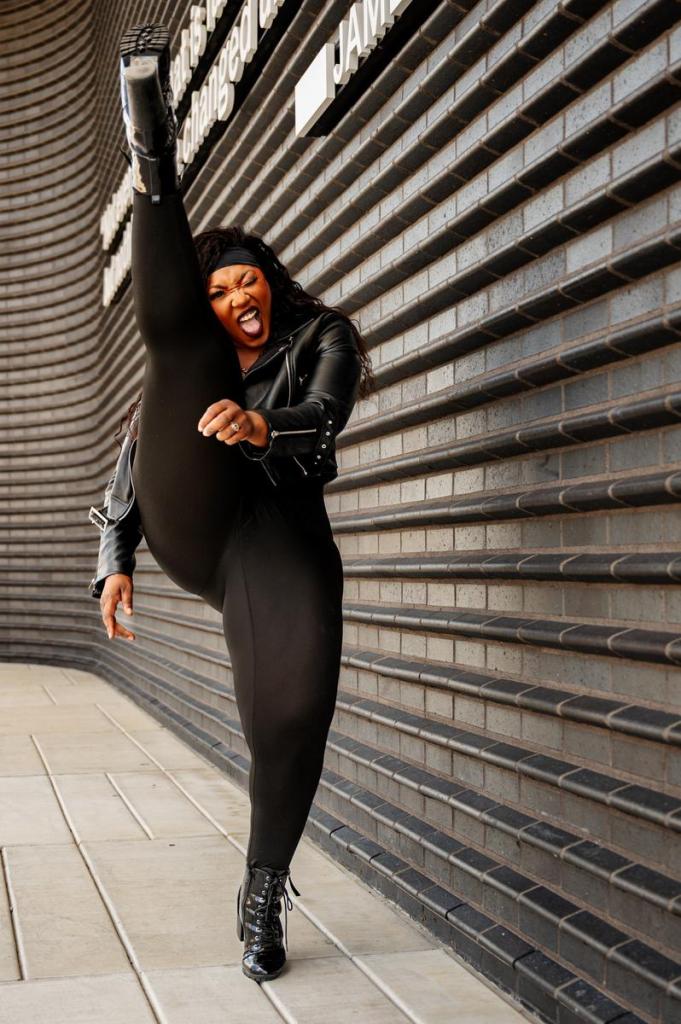
For the past several years, Rising has performed drag as Venus Rising, a self-described “blonde bombshell” like one of her idols, RuPaul.
“Venus is the part of me that is unleashed femininity,” she said. “I think she’s undeniable sensuality, sexuality. She’s glamour, she’s unencumbered, she’s body positivity, she’s fearless, she’s athletic, she’s strong, she can move every single curve in our body in a way that is not unlike a cobra.”
Like McHenry, Rising suppressed who she really was growing up. She described it as “hiding in plain sight.”
“I would go to a lot of gay ally groups as an ally — knowing how badly I wanted to kiss a girl,” she said. “I painted myself as an advocate and an ally just so I could remain in the spaces where I feel comfortable.”
She sees performing drag as a political act and says queer joy is activism: “When we refuse to let them wipe the smiles off our faces, that’s activism.”
People who find themselves at the intersection of being Black and queer speak a language — a cultural code — that is not easily translated. They are often hyper-conscious of balancing both identities, Rising told The Eagle.
While Black Queer Tulsa members participate in larger LGBTQ+-centric events around Oklahoma, the group is also intentional about creating culturally relevant activities targeted to African Americans.
“So we have all these things that cultivate queer experiences for Black people and Black experiences for queer people,” Rising said.
The group now has ambitions to expand statewide and has a series of events on the horizon. In August, the group will host a “day in the park” gathering. In October, the organization will celebrate Black Pride by hosting its first ball.
Over a decade after leaving his family’s church, McHenry said he finds joy in being able to create the community he didn’t have growing up.
As he reflected on his upbringing, he advises others who may be growing up under similar pressures to not internalize what they’re going through.
“When we’re going through things that are trauma-related, we internalize it and judge ourselves more than we need to,” he said. “Live life, understand life will throw you curveballs and lessons will need to be learned, but not everything is your fault.”
Now, he spends time with his chosen family — the network of people who he turns to for help and who make him feel like his best self. He’s no longer hiding out living out loud.
“I’m understood,” McHenry said. “And knowing that I can create those spaces for other people and give them the experience I’m currently having with my chosen family, it’s very rewarding.”