


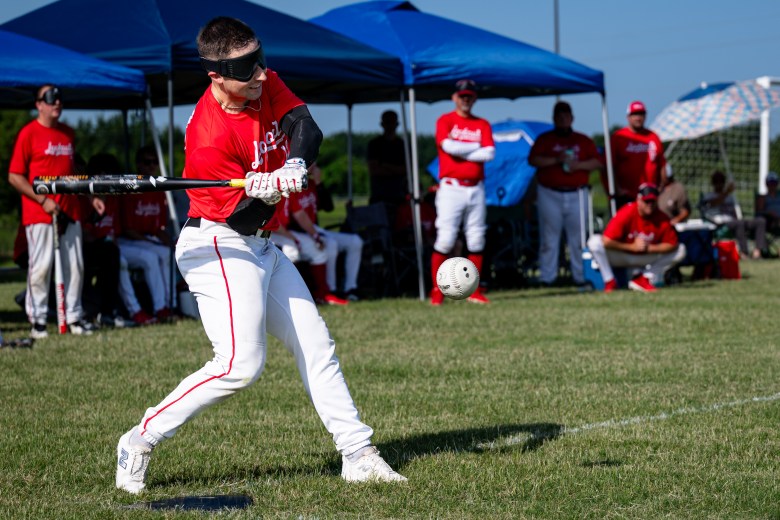
“I thought it was the dumbest sport in the world.”
Those were Mark Ivy’s feelings when he was first introduced to beep baseball at the age of 19.
“I was like, alright, dude, the ball’s beeping, the bases are buzzing,” he recalled.
A year earlier, he was playing traditional baseball at Jenks High School. Then he started losing his vision.
Now at 36, Ivy is a leader on the Oklahoma Lookouts, a beep ball team for low vision and blind players. This weekend, players took to the field for the fourth annual Sooner State Classic, which was hosted in Tulsa for the first time.
How the game works

Beep ball is an adaptive sport for people with low vision or who are blind. To even the playing field, everyone wears a blindfold when they’re on the field — except the pitcher, catcher and two sighted helpers on defense.
There are only first and third bases and they’re 100 feet away from home plate.
Batters have up to four underhanded pitches to get a hit. Once they make contact and it’s deemed a fair ball, they run to whichever base is buzzing. If they get there before the defenders find the ball that is steadily beeping and yell “up!” it counts as a run. If the defenders get to the ball first, they’re out.
The bases are 5 feet tall — think of a training bag in boxing — so runners literally run through the base, often tackling it or falling in the process.

A set of bases cost $400 and the balls cost $40 apiece, the team said.
On defense, your body is the glove. The sighters in the field can yell one number to help the six defenders move toward the beeping ball.
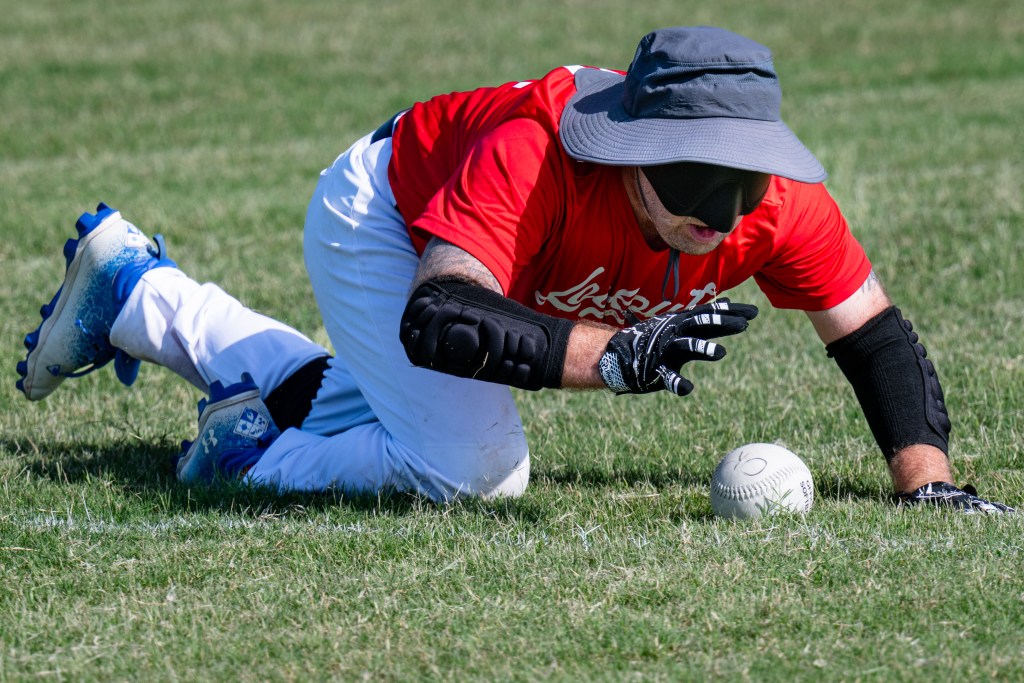
To the average person, Ivy knows it looks as wild as it sounds.
“They may think we’re crazy,” he said. “Yeah. Well, you know what? When they leave, they also think we’re crazy. But again, it’s an opportunity for us to play baseball.”
Unlike traditional baseball, the pitcher is on the batter’s team and actually wants you to get a hit.
For the Lookouts, it’s Tim Hibner. He started pitching for beep ball with the Oklahoma Bombers in 1984. He says tossing balls to hit the bat is a delicate work of precision.
“My cadence has to be the same,” said Hibner, a four-time champion. “(The batter’s) timing has to be the same, and then their swing has to be the exact same every time.”

When he’s on the mound, he’s talking to the batter letting them know when he’s released the ball and giving them cues on how they missed. He’s also tossing out phrases to keep them calm.
“My favorite is it’s just you and me here, just like practice,” he said. “You don’t have to worry about anybody sitting over in the bleachers, nothing.”
Gunner finds the hardest part of batting is self control — by the fans.
“People want to cheer when there’s a good hit but you can’t,” he said. “You have to wait until it’s over, so they can hear the ball or the base. Just let them get to the base. Let them get the ball, and then as soon as it’s over, then you cheer.”
Finding fellowship and purpose
Ivy, who’s a Boston Red Sox fan, will be the first to admit he’s competitive. The Lookouts finished fourth at this weekend’s tournament but he says the team is good enough to where it “hurts when they lose.”
Even then, it’s the connections on the team he values the most.
“It’s the most competitive thing I’ve ever played and you’re blindfolded, so it’s nuts,” Ivy said. “And I love it. I love it more than sighted baseball. The camaraderie of beep baseball is the best. That’s my favorite part about it.”

Players on the team range from teenagers to quinquagenarians, from former athletes to people who have never swung a bat or been part of a group.
“They don’t know what it’s like to jump on a team van, go to the team hotel, get in the pool,” he said. “I mean, you don’t know what funny is until you see 10 of us get off a team van and try to find a bathroom at QuikTrip.”
For Ivy’s teammate Chad Dillon, playing on the Lookouts has become a bit of an ironic moment.
“I was introduced to beep ball at 16 years old,” he said. “It was an Eagle Scout project to make beep ball bases. I didn’t know I had a debilitating retinal degenerative disease until I was 23. So it was kind of a cool little full circle moment.”
Dillon, who grew up a Kansas City Royals fan before switching to root for the St. Louis Cardinals, said the games also serve as a moment of release. Many players take the sport seriously.

“Our vision of all of our senses is the one that we rely on the most,” he said. “So taking that away and teaching people these folks can still live … it’s a great opportunity for people to realize that yeah, you know, blind people are people too.”
Since each of them spent part of their life with their full vision, they acknowledge the time since has been full of adapting.
“I drove till I was in my early 20s, I know what it’s like to be sighted,” Ivy said. “It’s very tough to adapt to just being on everyone else’s time. I don’t care how much your surrounding support system loves you; you’re still on their time.”
But beep ball has helped give Ivy a renewed zeal for life. He’s the adaptive sports manager at New View, a nonprofit that works with and employs people who are blind.
“When you wake up without a purpose in life, it sucks. Your people stop counting on you,” Ivy said. “At New View, we have people asking how to use a cane? How do I change my daughter’s diaper? So that same concept is brought into beep ball because what are you doing if you’re not doing this?”
And it’s given Dillon a chance to be an inspiration.
“Blindness is something that we deal with, but it’s not who we are,” he said. “Every single person on earth has something to overcome. My mountain may be a little bigger than yours, but we all have something to overcome. So the deal is to climb the mountain.”
