


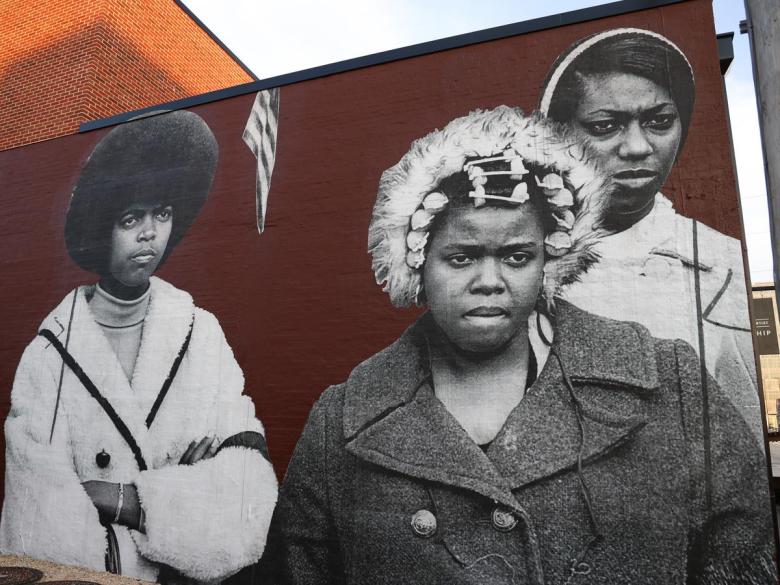
When Tatyana Fazlalizadeh first saw the photo, something about it pulled her in.
The Brooklyn-based artist was doing research on the Oklahoma Historical Society’s website for a solo exhibition in Oklahoma City. That’s when she came across the 1968 image of three Black women standing and staring straight ahead, a serious look on their faces.
“There’s no real context about where they are or what’s happening around them,” Fazlalizadeh told The Eagle. “I think what strikes me particularly about it is their facial expressions, the emotion that’s coming from them. I think seeing their faces sort of elicits something from you.”
It says something without saying anything, she said.
“That alone, I thought, would be very interesting to put at large scale in Tulsa,” the artist said.
So she turned it into one of Tulsa’s newest murals and her first in the city. It’s located at 109 MLK Jr. Blvd. on the Tulsa Artist Fellowship Studios building in the Arts District. Fazlalizadeh, who grew up in OKC, is in her second year as a fellow.

A lot of her work focuses on how women occupy and express themselves in public spaces. This piece is no different.
“To put up a piece that is of three Black women who are clearly angry, upset, distressed, but also stoic in the public space. What does that mean, or what does that say?” she pondered. “I’m curious about how people might politicize this image, even though it’s not necessarily a political image. I’m curious about how people will feel and respond.”
In some ways, Fazlalizadeh said, it’s a reflection of how she takes up space in the city.
“I’m walking down the street and I’m not necessarily as polite or as friendly as Tulsa folks are, or you know, smiling at people and all of that,” she said, “so to place that sort of expression at large scale in Tulsa, I think is different from what we see there.”
The mural won’t always be a part of the edge of the Greenwood District. Fazlalizadeh says it will be a rotating series, with plans to curate other artists who can offer their own styles. Regardless of what comes next, she thinks it will have a unique impact.
“Public art sort of confronts you in a way,” she said. “You’re not necessarily expecting to see it, you just come across it in the environment and I think there’s something very special about that.”
As she enters the second of her three-year fellowship, she has some other projects in the works. One is a public question — “what’s kept quiet in Tulsa that needs to be said out loud?” — that will influence one of her exhibitions.
Another is an iteration of her project “Stop Telling Women to Smile,” which is about gender-based violence and harassment. And while she’s not hurried by commemorations and anniversaries, Fazlalizadeh says she wants whatever she decides to have real meaning.
“With this series and this work, I’m trying to make public art that functions in a way that isn’t just decoration,” she said. “Public art can easily become decoration and in that sense it doesn’t do much at all for a city. This is me thinking, what can this actually do for the City of Tulsa?”
Disclosure: The Artists Creative Fund is a program of George Kaiser Family Foundation (GKFF). GKFF also provided financial support for The Oklahoma Eagle. News decisions at The Oklahoma Eagle are made independently of our board members and financial supporters. Read more about our editorial independence policy here.
